

Super El Niño Collides With Record Ocean Warming as Pacific Breaches 30°C
Equatorial Pacific temperatures have crossed 30 degrees Celsius for the first time on record, prompting climate scientists to set out emergency preparedness measures for a supercharged El Niño.

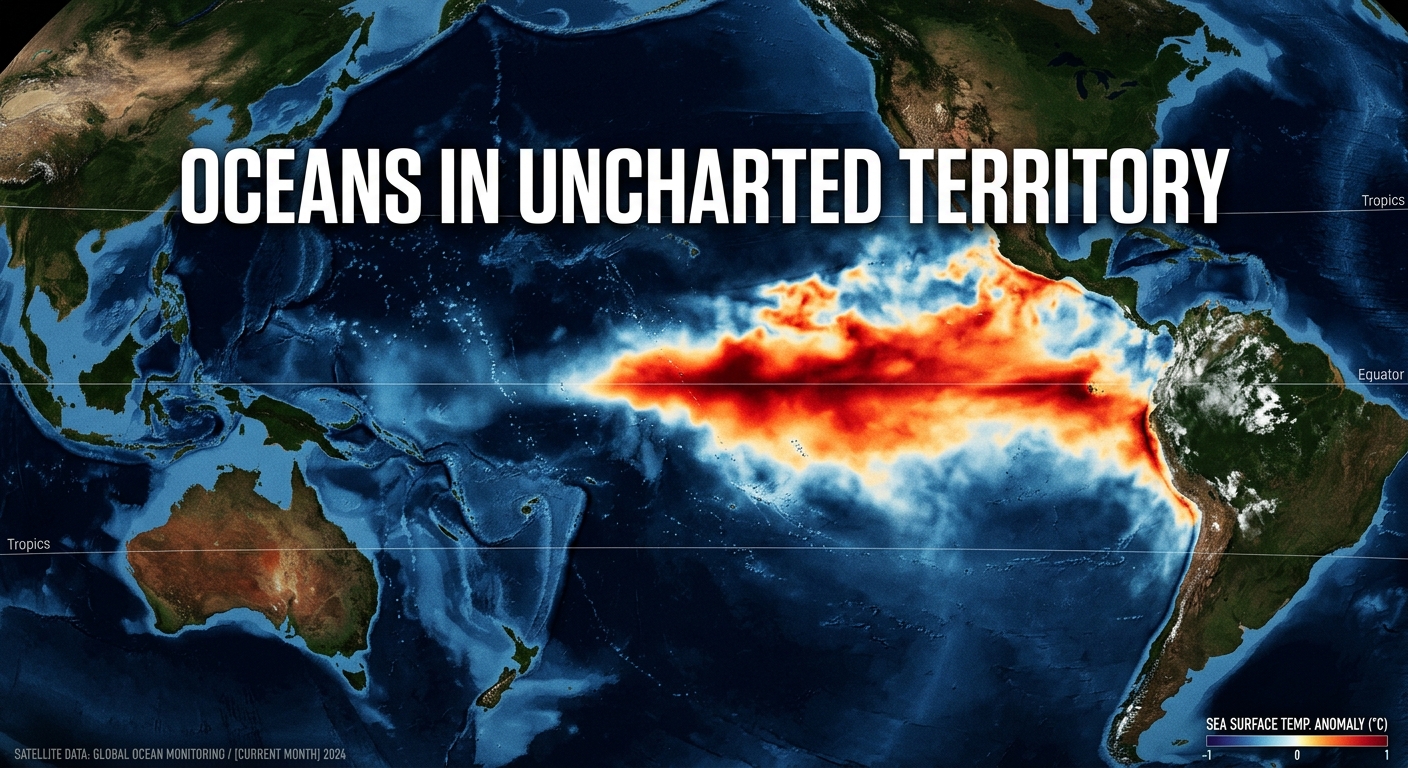
Surface waters across the equatorial Pacific crossed 30 degrees Celsius on October 5, 2026, marking the first time the Niño 3.4 monitoring region has reached that threshold in NOAA's Optimum Interpolation Sea Surface Temperature records. The milestone comes as meteorologists and climate scientists track a rapidly strengthening 2026 to 2027 El Niño event colliding with unprecedented baseline ocean heat.
The World Meteorological Organization declared the onset of the current El Niño on June 2, 2026. In the months since, ocean temperatures have steadily climbed into uncharted territory. On August 22, the European Union's Copernicus Climate Change Service recorded an all-time global sea surface temperature high of 21.11 degrees Celsius between 60 degrees North and 60 degrees South, breaking the prior record set in March 2024. By late September, central equatorial Pacific temperature anomalies hit 3.05 degrees Celsius above average, overtaking the previous record set during the powerful 2015 event.
Disentangling Natural Cycles From Baseline Heating
El Niño is a recurring climate pattern characterized by the sloshing of warm water toward the central and eastern tropical Pacific, releasing heat into the atmosphere and reconfiguring weather systems worldwide. Researchers emphasize that the current event is unfolding on top of decades of accumulated greenhouse warming.
Atmospheric scientists are using specialized metrics to distinguish natural ocean fluctuations from human-driven warming. NOAA's Relative Oceanic Niño Index tracks tropical Pacific temperatures relative to the warming tropical oceans as a whole. While absolute sea surface readings show anomalies surpassing 3.0 degrees Celsius, relative metrics show the regional Pacific anomaly climbing fast toward historic thresholds without yet eclipsing them. That difference illustrates why the present event feels so severe: global baseline temperatures are substantially higher than they were during previous super El Niño cycles in 1997 or 2015.
Berkeley Earth climate scientist Zeke Hausfather noted regarding recent measurements that Niño 3.4 regional anomalies reached 3.4 degrees Celsius above normal, sitting higher than comparable milestones in prior recorded events. Carlo Buontempo, director of the Copernicus Climate Change Service, cautioned that with ocean heat at these baselines, additional global temperature records will likely fall in the months ahead.
The Five-Step Scientific Roadmap
The convergence of extreme ocean heat and El Niño dynamics led a research team at the University of Bristol and the London School of Hygiene and Tropical Medicine to release a targeted policy roadmap on October 7, following an initial paper in The Lancet on September 16.
The scientists outlined five immediate steps for governments and international humanitarian bodies:
- Triggering public health protection protocols immediately upon an official El Niño declaration rather than waiting for post-disaster declarations.
- Deploying localized climate-health surveillance systems to catch outbreaks of waterborne and vector-borne diseases early.
- Establishing dedicated funding reserves for anticipatory health interventions in high-risk regions.
- Conducting formal climate-health attribution studies to mathematically separate background global warming from natural Pacific variability.
- Standardizing early warning metrics across regional health agencies to coordinate emergency supply chains.
"We know the number of people affected by climate-related disasters is strongly influenced by the El Niño cycle, but there is little evidence available establishing how much of the health burden can be attributed to climate change and how much was driven by El Niño," said Dr. Ruby Lieber, senior research associate in climate science at the University of Bristol. "Since the current El Niño pushes many regions into more extreme climates, there's a pressing and unprecedented need to better understand, measure and pinpoint the different dangers for individual countries and places."
Severe Shocks Already Underway
While models forecast the Pacific anomaly will peak between December 2026 and February 2027, compounding weather disruptions are already taking shape. Severe droughts, crop failures, and municipal water shortages have hit Colombia, Papua New Guinea, and the Philippines months ahead of the traditional winter peak.
United Nations agencies report that roughly 2.6 billion people worldwide are on track to experience unusually elevated temperatures through December, while 1.3 billion face heightened threats from extreme rainfall and flash flooding. UNICEF calculated that more than 347 million children across nearly 100 countries are currently exposed to abnormal wet or dry conditions driven by the event.
"For children, El Niño is far more than a weather pattern," said UNICEF Executive Director Catherine Russell. "It can mean increased displacement, malnutrition, water shortages and disease outbreaks."
Economic Payoffs of Early Intervention
The financial case for rapid action centers on prevention rather than rebuilding. United Nations disaster analysts calculate that every dollar spent on proactive risk reduction and anticipatory planning saves approximately 15 dollars in subsequent recovery and emergency response costs. Yet currently, less than one percent of international humanitarian aid is allocated to preventative preparation before disaster strikes.
With NOAA's Climate Prediction Center assessing an 83 percent probability that this event will rank among the strongest recorded since modern record-keeping began in 1950, health systems face a narrow window to deploy resources before peak disruptions hit this winter.
I’m a techie & gamer turned SEO strategist with a genuine passion for technology, AI, science, and gaming. I love exploring new technology, following the latest developments, and looking beyond the headlines to understand what is really happening. I write about the latest tech news, trends, products, tools, and ideas shaping our digital world. What I share is not just news. My articles include my own views, observations, and practical experiences, written in a simple and useful way. At Penguin Lens, I enjoy sharing what I discover, what I think, and what I believe readers should know, with the goal of making technology easier to understand and more interesting to explore.
Clinical Trial Finds HIIT Is the Only Aerobic Workout That Spares Muscle While Shedding Fat in Older Adults
More in Science & Future
 Science & Future
Why Taking Vitamin D2 Might Actually Lower Your Body's D3 Levels
 Science & Future
Restoring UBE2N Enzyme Reduces Damage in Advanced Fatty Liver Models
 Science & Future
Scientists Discover Hidden Giant Stick Insect Species Camouflaged for Decades
 Science & Future