

Meta Releases 816B Muse Spark Open Model Tuned for Apple Silicon Desktops
Meta partnered with Apple to optimize its 816-billion-parameter Muse Spark Open model for clustered M5 Ultra Mac Studios, challenging leading open-weight rivals.

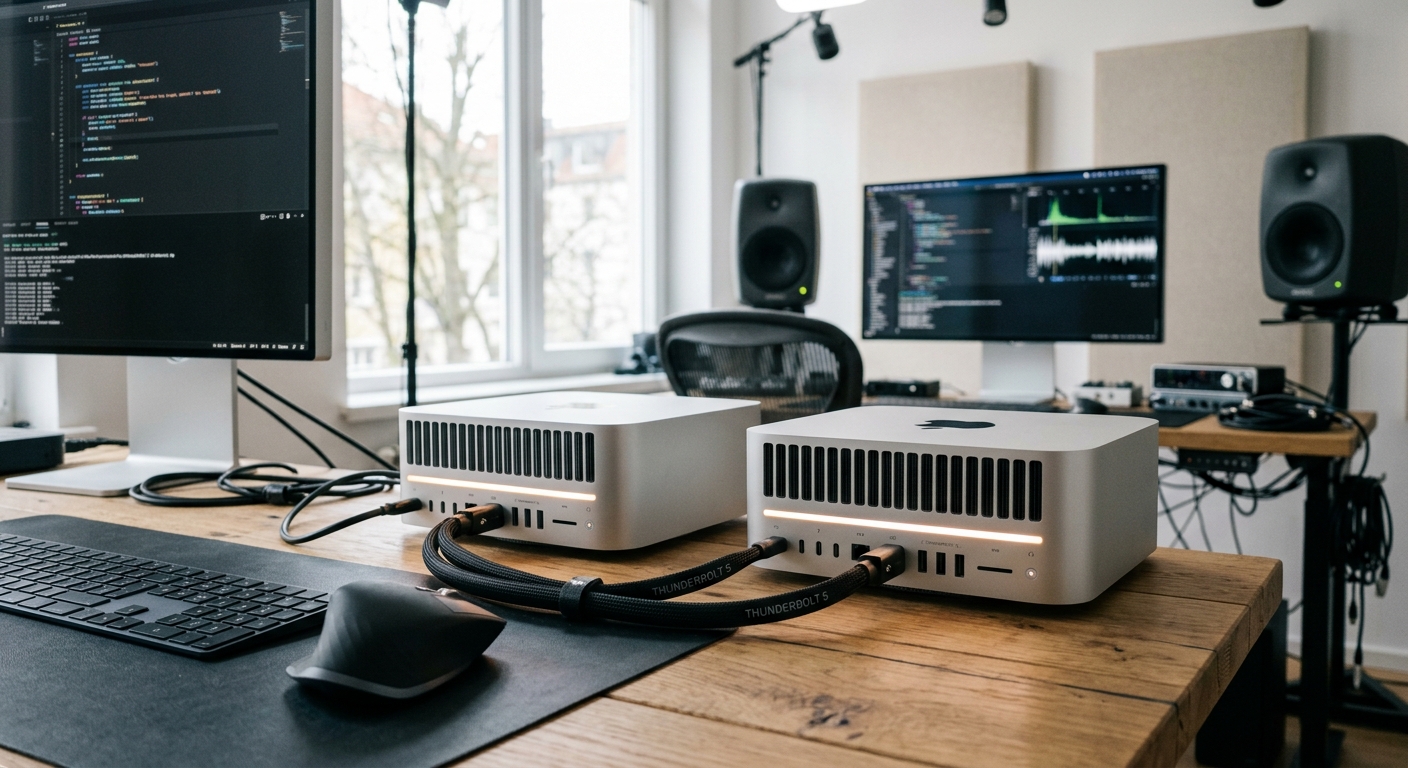
Meta has released Muse Spark Open, an 816-billion-parameter open-weight artificial intelligence model developed by Meta Superintelligence Labs and configured to run locally across clustered Apple Silicon workstations. The release reflects an uncommon technical collaboration between Meta and Apple, with Apple updating its open-source MLX machine-learning framework to distribute the model across multiple Mac Studio systems via Thunderbolt 5 interconnects.
The system uses a mixture-of-experts architecture with 256 total experts. During inference, top-8 routing activates roughly 42 billion parameters per token. The model includes a 1-million-token context window and accepts multimodal inputs across text, images, audio, and video while generating text output.
The Hardware Footprint on Apple Silicon
Running a model of this scale outside enterprise data centers presents severe hardware demands. Uncompressed BF16 language model weights require 1.63 terabytes of memory before runtime overhead, while compressed weights take up 493 gigabytes of storage before processing allocation.
To run Muse Spark Open locally without cloud infrastructure, Meta and Apple demonstrated configurations linking Apple M5 Ultra Mac Studios. Apple's unified memory architecture provides up to 512GB of memory per machine, paired with 1.2 terabytes per second of memory bandwidth. By connecting systems over Thunderbolt 5 with Remote Direct Memory Access, the hardware functions as a single memory pool.
Local execution requires either two 512GB Mac Studios or four 256GB machines to meet memory thresholds. In benchmark testing reported by Apple, a four-unit M5 Ultra cluster reached more than 36 tokens per second at an 8,192-token context length.
Meta noted in an engineering post that the architecture allows two 512GB machines to act like a single desktop computer with 1 terabyte of unified memory. Meta chief executive Mark Zuckerberg credited Apple senior vice president of hardware engineering John Ternus and Apple's engineering team for the joint MLX optimization work.
Benchmark Results Against Chinese Open-Weight Models
Alexandr Wang, chief of AI at Meta, described Muse Spark Open as the most capable US open-weight model to date, comparing it directly against leading Chinese open-weight systems such as Alibaba's Qwen, Moonshot AI's Kimi K3, and Z.ai's GLM 5.3.
Meta reported internal evaluations showing Muse Spark Open matching or exceeding those models on tool-use evaluations, including JobBench and MCP-Atlas. Other metrics show clear gaps. Meta's published model card and independent evaluations show the model trailing Kimi K3 and GLM 5.3 in terminal coding and extended software engineering tasks. On the Artificial Analysis Intelligence Index, Muse Spark Open scored 39, compared to 46 for MiMo-V2.6-Pro.
Distribution Formats, Quantization, and Cluster Costs
Meta published the weights under the Muse Model License on Hugging Face in BF16 and NVFP4 checkpoint formats. Cloud hosting is available through Amazon SageMaker JumpStart, Google Cloud Model Garden, and Microsoft Foundry Models, with inference support on MLX, llama.cpp, vLLM, SGLang, and Unsloth.
Open-source runtime developers moved quickly to lower hardware requirements. Unsloth issued dynamic GGUF quantizations on release day, introducing 2-bit quantization variants intended to fit within single 256GB memory footprints, though reduced precision alters output quality.
For teams considering dedicated local hardware, financial barriers remain high. While cloud providers charge by usage, assembling a physical Mac Studio cluster capable of handling unquantized or lightly quantized weights carries estimated hardware costs between $20,000 and $25,000 for two high-memory units, and up to $40,000 or more for four maxed-out systems.
Workstation Clusters Versus Cloud Accelerators
The joint project reflects shifting assumptions about where frontier AI models can run. High-parameter open weights have historically required dedicated server accelerators from Nvidia, confining local execution to enterprise server rooms. By tuning MLX drivers and memory pooling for desktop hardware, Apple and Meta are attempting to position unified-memory workstations as practical local platforms for large models, offering developers an alternative to hosted proprietary APIs.
Unresolved Pricing and Context Stability
Apple has not announced official retail pricing or a specific shipping date for the 512GB memory tier of the M5 Ultra Mac Studio beyond an expected late October 2026 window. Independent verification across everyday production tasks, particularly whether paired Mac Studios can sustain latency, memory stability, and throughput across the full 1-million-token context window, will ultimately determine whether desktop clustering proves practical for local operations.
I’m a techie & gamer turned SEO strategist with a genuine passion for technology, AI, science, and gaming. I love exploring new technology, following the latest developments, and looking beyond the headlines to understand what is really happening. I write about the latest tech news, trends, products, tools, and ideas shaping our digital world. What I share is not just news. My articles include my own views, observations, and practical experiences, written in a simple and useful way. At Penguin Lens, I enjoy sharing what I discover, what I think, and what I believe readers should know, with the goal of making technology easier to understand and more interesting to explore.
Ricursive Intelligence bets on AI-designed silicon to tackle compute crisis
More in AI
 AI
AIBig Tech Drops Data Center NDAs as Local Opposition Multiplies
 AI
AIMicrosoft CEO Satya Nadella Calls for AI 'Emergency Brake' and Zero-Trust Model Controls
 AI
AIWhy Did OpenAI Just Oust Three Top Safety Researchers?
 AI
AI