

How Fast Is Huawei's Kirin 9050 Pro? Early Geekbench Tests Give a Mixed Answer
Benchmark listings for Huawei's Mate 90 Pro Max reveal a 9-core CPU configuration and synthetic performance positioned between recent Qualcomm chips.

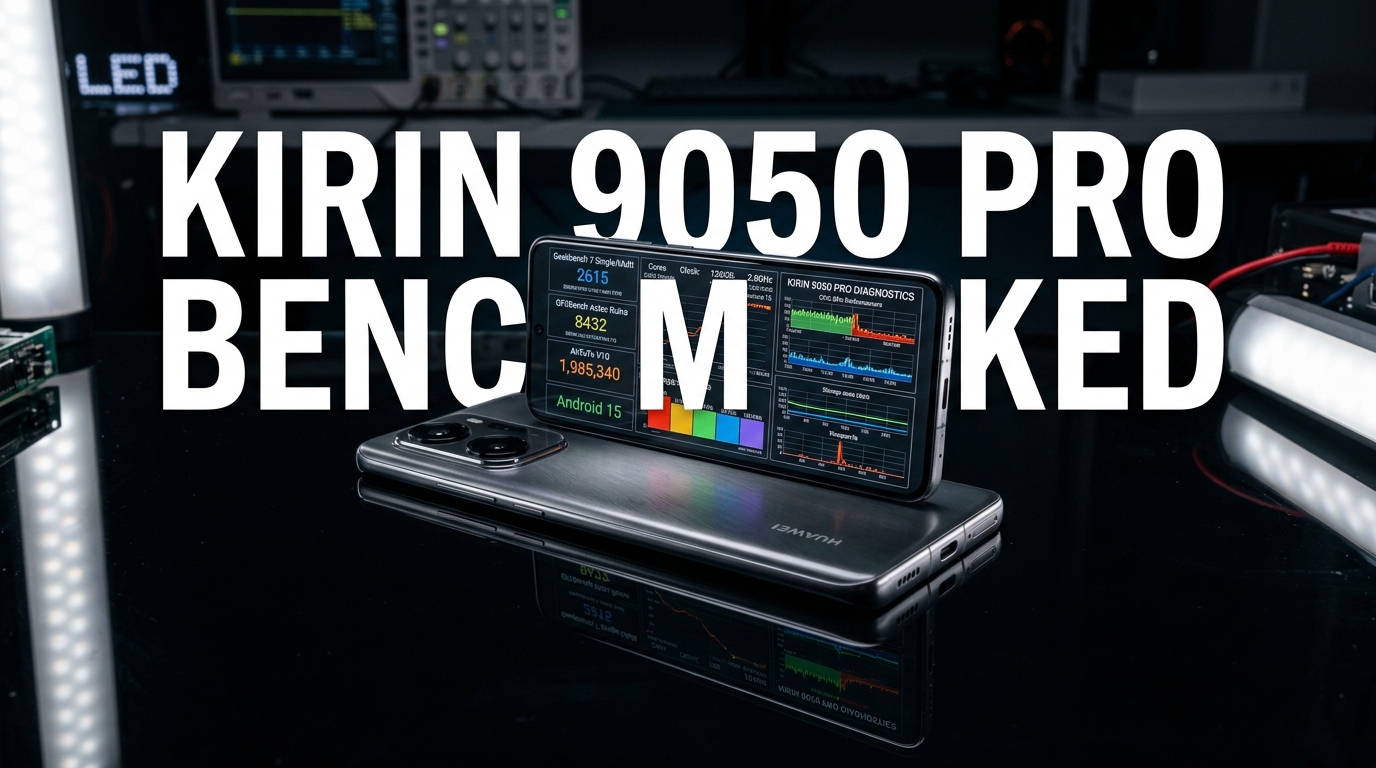
Initial benchmark listings for Huawei's Mate 90 Pro Max have appeared on Geekbench 7, detailing how the company's proprietary Kirin 9050 Pro silicon performs under synthetic workloads.
Core Layout and Maleoon GPU
Identified by model number CMM-AL10, the tested device runs on HarmonyOS. Geekbench data aggregated by GSMArena points to a 9-core CPU arrangement rather than a standard octa-core design:
- One primary ultra core running at 3.1 GHz
- Six performance cores split between 2.7 GHz and 2.2 GHz
- Two efficiency cores clocked at 1.75 GHz
For graphics, the processor integrates a proprietary Maleoon 955 GPU with six cores clocked at 1.05 GHz.
Geekbench 7 Results
According to GSMArena, the Mate 90 Pro Max averaged 1,317 points in single-core tests and 5,381 points in multi-core tests on Geekbench 7. Peak runs reached 1,528 in single-core and 6,169 in multi-core.
An earlier test reported by Notebookcheck recorded lower scores of 1,117 in single-core and 5,076 in multi-core. That discrepancy may reflect software translation overhead, as Android-based benchmark code ran inside Huawei's DroiTong container on HarmonyOS.
Comparisons to Snapdragon and Apple
Multiple outlets place the Kirin 9050 Pro's raw CPU performance between Qualcomm's Snapdragon 8 Gen 1 and Snapdragon 8 Gen 2, trailing newer flagship chips in raw single-threaded speed.
Multi-threaded workloads show closer parity with recent competitors. Bernstein Research reported that Kirin 9050 Pro multi-core performance on Geekbench 6 surpasses Apple's 3nm A17 Pro, though single-core output trails roughly 30 percent behind Apple's A20 Pro.
Reports citing ITHome state the Kirin 9050 Pro achieves generational gains over its predecessor, including a 23 percent rise in multi-core CPU performance, 40 percent faster GPU rendering, and a 140 percent improvement in neural processing unit output.
Architecture and Model Discrepancies
Bernstein Research reported that Huawei used a 3D stacking method called LogicFolding, which elevates transistor density to roughly 238 million transistors per square millimeter. Huawei has not disclosed the production node, though research analysts point to SMIC's 7nm-class N+2 or N+3 fabrication tech.
Model labeling remains inconsistent across sources. TrendForce previously stated that the Kirin 9050 Pro would be exclusive to the Mate 90 RS and Collector's Edition variants, while the standard Pro Max would carry a base Kirin 9050. However, Geekbench listings identify the tested Pro Max unit with the Pro chipset. Preliminary database entries also initially showed an octa-core setup with a Maleoon 935F GPU before the 9-core listing stabilized.
The Mate 90 Pro Max is available in China starting at 9,499 yuan for the 12GB RAM and 512GB storage configuration.
I’m a techie & gamer turned SEO strategist with a genuine passion for technology, AI, science, and gaming. I love exploring new technology, following the latest developments, and looking beyond the headlines to understand what is really happening. I write about the latest tech news, trends, products, tools, and ideas shaping our digital world. What I share is not just news. My articles include my own views, observations, and practical experiences, written in a simple and useful way. At Penguin Lens, I enjoy sharing what I discover, what I think, and what I believe readers should know, with the goal of making technology easier to understand and more interesting to explore.
Why Siri AI Might Not Reach European iPhones Anytime Soon
More in Mobile
 Mobile
The iPhone 18 Pro Just Gained Physical Aperture Video Control
 Mobile
Stop Wasting Money: 5 Phones Under ₹8,000 That Actually Work
 Mobile
Oppo Put an 8,000mAh Battery and IP69K Durability in a Sub-$300 Phone
 Mobile